Lucky Numbers India Guide: Meanings by Tradition and Context
Lucky Numbers India Guide: Meanings by Tradition and Context. Understand why number associations in India vary by language, religion, region, family practice, a
Quick Answer: There is no single list of lucky numbers used throughout India. Numbers such as three, seven, eight, and nine can carry positive associations in particular religious, linguistic, family, or numerological settings, but the reason matters more than the number alone. Check the community, occasion, source, and stated method before applying a meaning. Treat the result as cultural context, not a prediction about money, health, marriage, safety, or success.
Indian number associations and context boundaries
- Core boundary
- India does not have one universal list of lucky numbers shared by every community.
- Context fields
- Record the language, region, religious or family tradition, occasion, and source before interpreting a number.
- Common examples
- Three, seven, eight, and nine may appear in different symbolic or numerological settings, but their meanings are not interchangeable.
- Practical limit
- A cultural association does not predict health, money, relationships, safety, or business outcomes.
- Best use
- Treat a number belief as a clue about a speaker's context, then ask what the number means in that specific setting.
Start with context, not a national list
# Lucky Numbers India Guide: Meanings by Tradition and Context Searching for lucky numbers in India often produces a neat list. Real practice is less tidy. India contains many languages, religions, regional customs, family traditions, and modern numerology systems. A number that matters in one ritual or household may be ordinary in another. The useful question is therefore not simply, "Which number is lucky?" It is, "Who uses this association, in what setting, and according to which tradition?" This guide provides a context-first way to read number beliefs without turning them into a national rule. It also separates repeated ritual counts, language-based associations, family preferences, and modern numerology. None of these can guarantee an outcome.
The phrase "lucky numbers India" can imply that a country of more than a billion people follows one chart. That assumption removes the information a reader most needs. A number may appear because a ceremony repeats an action a certain number of times, because a story has a familiar group of figures, because a family follows an astrologer or numerologist, or simply because a person likes a date.
Begin by naming the level of the claim. Is it about one household, one language community, one religious practice, a regional custom, or a modern commercial numerology service? A family preference should not be upgraded into a regional tradition, and a regional tradition should not be presented as a rule for India as a whole.
The same caution applies when someone says that a number is "auspicious." Ask what action or object it describes. A repeated count in a ritual is not automatically a preferred house number. A number associated with a deity or narrative is not automatically a recommended business number. Context changes the claim.
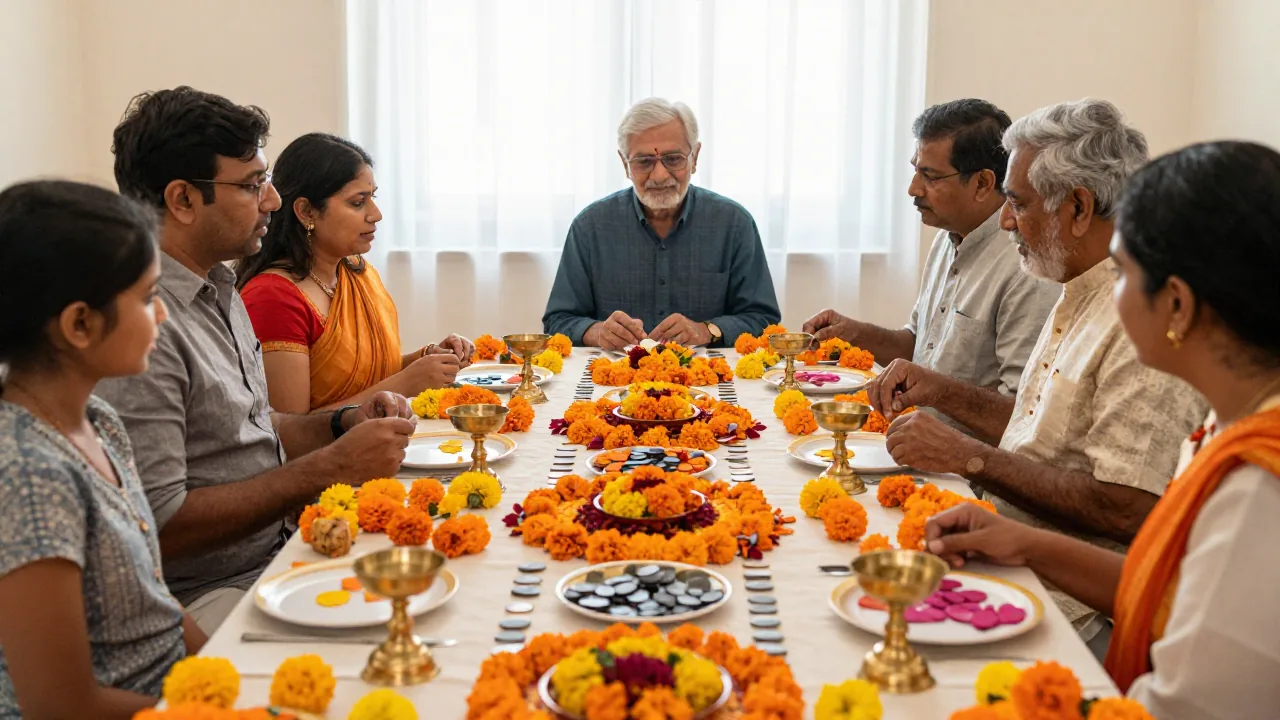
Why three, seven, eight, and nine appear in different conversations
Readers often encounter these numbers in lists, but the list format hides their different sources. Three may be connected with triads in religious or philosophical discussion. Seven may appear in ceremonial steps, grouped ideas, or family retellings. Nine may be associated with grouped forms, festival patterns, or completeness in particular contexts. Eight may enter through modern numerology, personal preference, neighboring cultural influence, or a specific consultant's method.
Those examples are prompts for source checking, not a national ranking. They do not mean every Indian person considers these numbers fortunate. They also do not mean that the four numbers share one historical explanation. When a page gives the same one-line definition for every community, it is probably flattening several traditions into a generic lucky-number chart.
A stronger explanation includes the name of the practice, the place or community where it is documented, and the type of source. It should also make clear whether the claim is historical description, present-day observation, family testimony, or a modern numerology interpretation.
Separate ritual repetition from modern numerology
Ritual repetition and numerology may both involve numbers, but they answer different questions. A ritual count belongs to a specific sequence of actions and meanings. It is interpreted within that ceremony. Modern numerology usually converts a name, date, address, or other input through a declared calculation system and then attaches symbolic language to the result.
The distinction matters because a ritual count should not be copied into an address or phone-number calculation without evidence. Conversely, a numerology result should not be described as an ancient ritual rule merely because both use the same digit.
When reading a numerology claim, write down the inputs and method. Did the calculation reduce a date? Did it preserve a so-called master number? Did it use a letter-to-number chart? Different conventions can produce different outputs. Our [lucky number calculator guide](/guide/lucky-number-calculator-how-to-use/) explains why the method should be declared before a result is interpreted.
For broader background, the Wikipedia overview of numerology describes numerology as assigning meaning to numbers and names. That overview is useful for defining the category, but it does not prove that one interpretation applies across Indian communities.
Language and pronunciation need local evidence
Some East Asian number traditions are widely explained through sound-alikes. Readers sometimes transfer that model to India without checking the relevant language. India is multilingual, so a pronunciation claim must name the language and the actual word being compared. A similarity in Hindi may not exist in Tamil, Bengali, Marathi, Telugu, Gujarati, Punjabi, or another language.
Do not accept a claim that says "in Indian, this number sounds like..." India does not have a language called Indian. Look for the language name, the original script or a reliable transliteration, and a source that explains the comparison. If those pieces are missing, keep the claim unverified.
Language evidence can also change over time and by dialect. A modern social-media explanation may be a recent wordplay rather than a long-standing custom. That does not make it meaningless to the people using it, but it changes how the claim should be labeled.
Family practice can be real without being universal
A family may consistently choose certain dates, gift quantities, or combinations because elders taught them to do so. That is genuine family practice. It does not need to be universal to matter. The accurate description is simply narrower: "In this family, this number is preferred for this occasion."
Ask how the practice was learned. Was it passed down orally, advised by a religious specialist, chosen by a numerologist, or adopted after a memorable event? Record who explained it and when. A dated family account is more useful than an anonymous claim that "Indians believe" something.
Personal preference should also be allowed to remain personal. A favorite number may come from a birthday, sports jersey, school roll number, or a positive memory. It may have no wider cultural explanation. Our guide to [finding a personal lucky number](/guide/how-to-find-your-lucky-number/) can be used as a reflection exercise, but its result should not be presented as objective evidence.
Ask five questions before using a number meaning
First, who is making the claim? Identify the family member, community source, author, priest, astrologer, or numerologist. Second, where does the association apply? Name the region, language, ceremony, object, or decision. Third, what is the source type? Separate a historical text, museum explanation, interview, commercial service, and social post.
Fourth, what method connects the number to the meaning? A repeated ceremonial count, a story, a pronunciation, and a digit-reduction calculation are not interchangeable. Fifth, what is the practical boundary? The number may help someone describe identity or preference, but it cannot replace evidence-based checks.
For example, a house-number preference does not replace an inspection, budget, legal review, or safety assessment. A wedding-date preference does not determine relationship quality. A business-number preference does not establish demand, cash flow, or compliance. See our [house-address number guide](/guide/lucky-numbers-for-house-address/) for a clear separation between symbolic reflection and property decisions.

Build a source note instead of a lucky list
A simple source note is more durable than a ranking. Write the number, the claimed meaning, the community or language, the occasion, the source, the date you accessed it, and any conflicting explanation. If a claim cannot be tied to a context, label it as unverified rather than filling the gap with a generic definition.
When two sources disagree, do not force a single answer. They may describe different regions, periods, or methods. Preserve both with their scopes. The disagreement itself is useful evidence that the meaning is not universal.
This approach also prevents accidental promises. A source note can say that a number is preferred or avoided in a particular setting. It should not say that choosing the number will create wealth, prevent harm, or secure a desired result.
A context-first source check
- Name the language, region, community, or family behind the claim.
- Separate ritual counts, stories, pronunciation, and modern numerology.
- Record the source type and access date.
- Treat personal preference as personal unless wider evidence exists.
- Do not use symbolic numbers instead of financial, legal, health, safety, or relationship judgment.
- Keep conflicting meanings visible rather than inventing one national rule.
Questions about lucky numbers in India
What is the luckiest number in India?
There is no single answer for all of India. A number can be favored in a particular family, ritual, language community, region, or numerology system. Ask for that context before treating a claim as meaningful.
Is seven considered lucky in India?
Seven appears in several cultural and ceremonial settings, but that does not establish a universal preference for every person or every decision. Identify the specific practice and source.
Is eight lucky in India for the same reason it is lucky in China?
Not automatically. Chinese explanations often cite language-specific sound associations. An Indian claim needs its own regional, linguistic, family, or numerological evidence rather than a borrowed explanation.
Can I choose an Indian lucky number for my house or phone?
You can use a symbolic preference for personal reflection, but it cannot guarantee an outcome. Keep practical checks such as cost, contracts, safety, privacy, and usability separate.
How can I verify a lucky-number claim about India?
Look for the named community or language, the occasion, a clear source, and the mechanism connecting the number to its meaning. Treat broad unsourced lists as starting points for research, not established national facts.